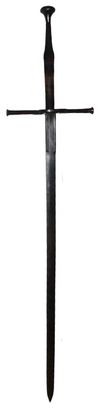
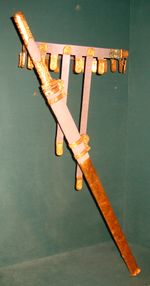
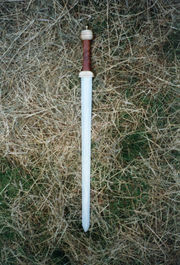
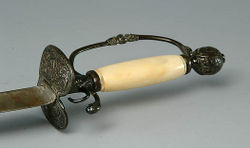
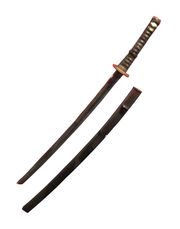
Sword (from Old English sweord, cognate to Old High German Schwert, literally "wounding tool" from a Proto-Indo-European root *swer- "to wound, to hurt") is a term for a long edged weapon, fundamentally consisting of a blade, usually with two edges for striking and cutting, a point for thrusting, and a hilt for gripping. The basic intent and physics of swordsmanship remain fairly constant, but the actual techniques vary among cultures and periods as a result of the differences in blade design and purpose. The names given to many swords in mythology, literature, and history reflect the high prestige of the weapon (see list of swords).
History
Bronze Age
Humans have manufactured and used bladed weapons from the Bronze Age onwards. The sword developed from the dagger when the construction of longer blades became possible, from the early 2nd millennium BC. The hilt at first simply allowed a firm grip, and prevented the hand from slipping onto the blade when executing a stab. Bronze Age swords with typical leaf-shaped blades first appear near the Mediterranean and the Black Sea, and in Mesopotamia. Swords from the Nordic Bronze Age from ca. 1400 BC show characteristic spiral patterns. Sword production in China is attested from the Bronze Age Shang Dynasty.
Read more at Wikipedia.org