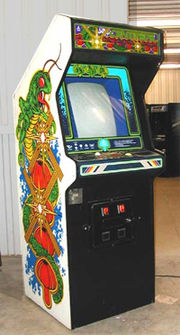
Arcade
An arcade game is a coin-operated entertainment machine, typically installed in businesses such as restaurants, pubs, video arcades, and Family Entertainment Centers. Most arcade games are redemption games, video games or pinball machines. more...
History
See also: Timeline of arcade game history
The first popular "arcade games" were early amusement park midway games such as shooting galleries, ball toss games, and the earliest coin-operated machines, such as those which claim to tell a person their fortune or played mechanical music. Although none of these were coin-operated games themselves, the old midways of 1920s-era amusement parks (such as Coney Island in New York) provided the inspiration and atmosphere of later arcade games.
In the 1930s, the earliest coin-operated pinball machines were made. These early amusement devices were distinct from their later electronic cousins in that they were made of wood, did not have plungers or lit-up bonus surfaces on the playing field, and used mechanical instead of electronic scoring readouts. By around 1977, most pinball machines in production switched to using solid state electronics for both operation and scoring.
In 1972, Atari was formed by Nolan Bushnell and Ted Dabney. Atari essentially created the coin-operated video game industry with the game Pong, the smash hit electronic ping pong video game. Pong proved to be popular, but imitators helped keep Atari from dominating the fledging coin-operated videogame market. Nonetheless, video game arcades sprang up in shopping malls and small, "corner arcades" appeared in restaurants, grocery stores, bars and movie theaters all over the United States and other countries during the late 1970s and early 1980s. Games such as Space Invaders (1978), Galaxian (1979), Pac-Man (1980), Battlezone (1980), and Donkey Kong (1981) were especially popular.
Read more at Wikipedia.org